TestComplete issues with Chrome 113
Hey, this is a general message about TestComplete issues with Chrome 113 Please note that the current version of our product may experience issues when used with Google Chrome 113. We apologize for any inconvenience this may cause. Our team identified this is Chrome issue and we are working on a permanent fix. We appreciate your patience as we work through this issue. The dev team on our side is already working to solve the problem. We expect the problem to be solved by the middle of next week. More updates will be provided here in this thread. Really appreciate your patience and sorry for inconveniences. Best regards, Pawel Mularczyk Product Manager for TestComplete19KViews6likes139CommentsUpdate Regarding TestComplete Web Issue
Hello, Recently, Chrome and Edge versions 113 caused issues with TestComplete. When this occurred, our development team worked diligently to solve the problem. Google and Microsoft have now released an update to roll back these changes, stabilizing the TestComplete web testing experience. While these changes didn’t stem from TestComplete directly, we do find it of the utmost importance to always provide you with a high performing tool. With additional browser updates planned in the future, we have already taken steps to prevent major outages like this from occurring again. Our teams plan to: Continue to validate beta versions of upcoming browser updates Ensure that breaking issues are always the top priority Release a TestComplete update to ensure upcoming browser versions are not impacted (recently released new version to support Chrome 114 and Edge 114) We’re always committed to delivering the highest quality tools to your team. Thank you for your ongoing patience and continued partnership. Best, The TestComplete Team424Views3likes2Comments
Test Steps are not loading intermittently
Has anyone else experienced this issue? I and some other team members are seeing this issue. Sometimes test steps don't load and we need to refresh the test case 3-4 times. This is happening with new and existing test cases. Not seeing any Zephyr API issues that I can report.1.1KViews3likes4Comments
OCR in UI Test Automation: Extending Coverage Where Traditional Identification Breaks Down
Automated UI testing increasingly operates in environments where traditional object identification is not reliable. Modern applications frequently render text and controls using custom graphics, canvases, charts, and dynamically generated visuals that do not expose accessible properties or stable locators. As a result, automation tools that rely solely on object hierarchies and properties can struggle to validate what is actually presented to the user. Optical Character Recognition (OCR) addresses this gap by enabling automation to extract and interpret text directly from what is rendered on screen. Instead of depending on the underlying implementation of a control, OCR works at the visual layer, analyzing pixels and patterns to recognize characters and convert them into machine readable text. This capability allows automated tests to validate user visible content in situations where traditional approaches fall short. Why OCR Matters in Real World UI Testing In many business critical applications, text is not always exposed through standard UI controls. Common examples include: Charts and dashboards rendered using custom drawing libraries Canvas based interfaces and rich graphical components Embedded documents such as PDFs or reports Custom buttons, labels, or alerts built without standard accessibility metadata In these scenarios, the risk is not just test fragility it is blind spots. If automation cannot confirm what text is displayed, teams are forced back to manual validation for critical user facing information. OCR enables tests to verify visible content regardless of how it is implemented. By converting visual text into actionable data, OCR allows teams to assert that values, labels, messages, and statuses shown to users are correct, even when object level access is unavailable. This makes OCR especially valuable for validating end-to-end business workflows where correctness depends on what users actually see, not just what the application internally represents. OCR as Part of TestComplete’s Object Recognition Strategy TestComplete incorporates OCR as part of its broader approach to handling complex and non standard user interfaces. OCR is available directly within the platform and can be applied to many different types of application testing without requiring separate tools or configurations. When TestComplete encounters unsupported or custom controls, OCR can be used to: Recognize text from a specified screen region Extract and compare visible text against expected values Locate UI elements based on displayed text rather than coordinates Interact with visual elements by identifying their text content OCR actions can be recorded automatically during test creation when traditional object recognition is not possible. Teams can also explicitly define OCR based checkpoints to validate messages, labels, and dynamic values that appear during test execution. By allowing interactions to be driven by recognized text instead of fixed screen positions, OCR based tests tend to be more resilient to layout changes and UI adjustments. See OCR in Action A short demonstration shows how OCR is applied in real testing scenarios, including recognizing text in custom or unsupported controls, validating user visible messages, and driving interactions based on on screen text rather than fixed coordinates. The demo focuses on practical use cases where traditional object identification is not available. Expanding Automation Coverage Without Increasing Fragility One of the persistent challenges in UI automation is balancing coverage with maintenance. Scripts that rely on brittle locators or coordinates often fail when visual layouts change, even if the underlying functionality remains correct. OCR helps mitigate this issue by anchoring tests to user visible content rather than implementation details. This is particularly useful for: Validating alerts or error messages drawn directly on the UI Verifying values inside charts or graphical widgets Testing applications with frequent visual refinements but stable business logic By enabling validation at the visual layer, OCR reduces the need for workarounds or manual testing in areas that were previously difficult to automate. The result is broader coverage with fewer fragile dependencies. OCR as a Bridge Between User Experience and Automation OCR is not intended to replace traditional object based testing. Instead, it complements it by extending automation into areas where conventional techniques are insufficient. Within TestComplete, OCR functions as a bridge between how users experience an application and how automated tests validate it. When automation can read and verify the same information a human user relies on, test results better reflect real world behavior and risk. As applications continue to evolve toward richer and more visually driven interfaces, OCR plays a key role in ensuring automated testing remains aligned with actual user experience not just underlying code structure.323Views2likes0Comments
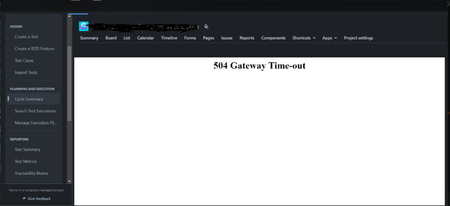
Zephyr squad loading issue - 504 bad gateway timeout.
Since from yesterday i.e. 08/08/2023 till now Zephyr squad loading issue as not been resolved and if it access and try to edit/add new TC's, currently the update is not happening. Also if user deletes any of the test steps in middle of the TC, its not reflecting. Please look into the issue and request to resolve on priority basis.418Views2likes1Comment
Duplicated test steps in cloned tests in Zephyr Squad
Hi, I’m getting an issue where, if I clone a test which was cloned from another test, the test steps are sometimes duplicated. I only notice this when I save the test and go back into it. e.g. original test [10 steps] -> cloned test 1 [10 steps, works fine] -> clone of cloned test 1 [20 steps, with all steps duplicated] has anyone else seen this?473Views2likes1Comment
Exporting JIRA and Zephyr Field to get a complete view of test cases executions
When exporting from Zephyr into an Excel spreadsheet the only filed available are the Zephyr fields. Other JIRA filed associates with a test case like comments, description, attachment, etc. ... are not included. We need to do multiple exports from JIRA and Zephyr to get all the information we need, merge documents to get all we need in the report. Questions: is there a way to export the JIRA Field and the Zephyr Field together? Is there an add-on or apps that we can install, integrate and use that would solve the issue? Thanks for your help.938Views2likes0CommentsBeating SAP Testing Bottlenecks with TestComplete
Testing SAP is hard for all the familiar reasons, complex UIs, transports that tweak screens, sensitive data, and heavy audit needs. Below are the common bottlenecks and how TestComplete helps you cut through them. Fragile object locators in SAP GUI The bottleneck: SAP GUI controls can be tricky to identify reliably minor UI changes or different dynpro states can break scripts. How TestComplete helps: It provides native support for SAP GUI for Windows with extended objects (buttons, edit fields, grids, etc.), so you work with properties and methods not coordinates. Pair that with Name Mapping (a central, alias-based object repository) to make tests readable and resilient. 2) UI drift after transports equals flaky tests The bottleneck: After a support pack or transport, object properties change and tests fail even though the flow still works. How TestComplete helps: Self healing tests automatically look for close matches when an object isn’t found, reducing “false red” failures and maintenance. 3) “Hard” screens, canvas elements, or remote sessions The bottleneck: Custom controls or canvases don’t expose stable object trees. How TestComplete helps: Use AI-powered OCR (and the OCR Action in Keyword Tests) to find text on screen and create easy validation as a fallback when classic object IDs aren’t reliable. 4) Test data sprawl (pricing, partners, plants…) The bottleneck: You need many variants to cover conditions, taxes, partners, plants, and languages without hand cloning tests. How TestComplete helps: Built-in data driven testing lets you drive one test with rows from Excel/CSV/DB, multiplying coverage while keeping scripts lean. 5) Audit evidence for SOX/GxP The bottleneck: Auditors want traceable, reviewable evidence: who ran what, where it clicked, and what was on screen. How TestComplete helps: Test Visualizer captures step-by-step screenshots during record/playback; Video Recorder can capture full-run videos; detailed logs tie everything together. These are ideal for defect triage and audits. 6) CI/CD traceability (and repeatability) The bottleneck: Manual runs don’t scale; teams need runs linked to commits/builds. How TestComplete helps: Use the Jenkins plugin to trigger suites in jobs or Pipelines and view results in Jenkins, creating a clean chain of custody for each build. Final thought SAP is always changing, your tests shouldn’t break every time it does. TestComplete’s native SAP GUI support, Name Mapping, self-healing, OCR fallback, and data-driven runs help you keep testing stable and audit friendly with less maintenance. The following demo illustrates these features in practice, automating the creation of a purchase requisition within SAP while maintaining stability across UI changes.Accelerating Quality: How TestComplete Leads in Test Creation, Execution, and Object Recognition
Temil Sanchez, the new Product Manager for TestComplete, shares insights from a recent evaluation comparing TestComplete and Ranorex. TestComplete stood out for its faster test creation, intuitive interface, and superior object recognition, which reduce maintenance and ensure robust automation. Looking ahead, the focus is on integrating AI to further accelerate test creation, enhance resilience, and help teams release quality software faster.126Views1like0Comments