TestComplete – “Token Expired” Error Occurring Repeatedly
Hi everyone, I have been facing a “Token Expired” issue in TestComplete for the past two days. Every time I try to use TestComplete, I receive the token expired error. I faced the same issue previously, and the TestComplete Community/Support team suggested removing the cache files and uninstalling and reinstalling TestComplete. I followed those steps, and the issue was resolved at that time. However, the same problem has started occurring again, and I am repeatedly receiving the “Token Expired” error even after trying the previous solution. Could someone please help me understand why this issue keeps occurring and suggest a permanent solution? Details: Product: TestComplete Issue: Token Expired Duration: Past 2 days Previous solution tried: Removed cache files and uninstalled/reinstalled TestComplete Current status: Issue is occurring repeatedly I would really appreciate any guidance or troubleshooting steps to resolve this issue permanently. Thank you in advance for your help.79Views0likes1Comment
TestComplete is prepending to the PATH when it launches and breaks/blocks our users Python installs
We have several users that are experiencing the following: Python 3.14 installed in default location Python added to PATH TestComplete launches and prepends its own Python to the PATH and causes users tests to run. I need to stop TC from adding to the PATH when it launches. Thanks in advance. Mark70Views0likes1Comment
TestComplete support for Delphi 13 desktop application with DevExpress VCL 25.2 or newer
Hello, We are evaluating TestComplete for automated GUI testing of a Windows desktop application developed in Delphi. Our application stack is: Delphi 13 / RAD Studio 13 VCL desktop application DevExpress VCL components version 25.2 or newer Main controls used in the application include TcxGrid / QuantumGrid, TcxTreeList, TcxButton, TcxTextEdit, TcxComboBox, TdxRibbon and TdxBarManager We would like to confirm whether TestComplete officially supports testing desktop applications built with Delphi 13 and DevExpress VCL 25.2 or newer. In the TestComplete documentation, we found information about extended support for Developer Express VCL controls, but the listed supported versions appear to go only up to DevExpress VCL 21.1.x.142Views1like5CommentsSessioncreator CLI never returns ERRORLEVEL 1
I noticed this a while ago, when using Sessioncreator through the CLI the documentation says this: @echo off "C:\TestCompleteFolder\Bin\TestComplete.exe" "C:\TestCompleteProjects\MyProj\MyProj.mds" /run /exit IF ERRORLEVEL 1001 GOTO NotEnoughDiskSpace IF ERRORLEVEL 1000 GOTO AnotherInstance IF ERRORLEVEL 127 GOTO DamagedInstall IF ERRORLEVEL 4 GOTO Timeout IF ERRORLEVEL 3 GOTO CannotRun IF ERRORLEVEL 2 GOTO Errors IF ERRORLEVEL 1 GOTO Warnings IF ERRORLEVEL 0 GOTO Success IF ERRORLEVEL -1 GOTO LicenseFailed But when warnings are in the logs I only get ERRORLEVEL 1 (Success). This has been an issue for at least the past 3 years. Overal not a big issue, I was just wondering if it's just me.Solved218Views0likes9CommentsSessionCreator returns exitcode: 7 Failed to create user session
I currently have an issue on only 1 of my test machines where the testrun never starts and the exitcode is 7 with the message "Failed to create user session" This machine runs 2 projects and has worked for about 2 years, now since January 6 it won't start the testrun anymore. To go back to the basics I even made a new bacthscript to start the run with only the minimal required code. "C:\Program Files (x86)\SmartBear\TestExecute 15\x64\Bin\SessionCreator.exe" RunTest /Username:"<PCName>\<UserName>" /Password:"<Password>" /ProjectPath:"<PathToPJS>\<ProjectSuite>.pjs" /ScreenResolution:1920*1080 /Timeout:9000 /project:"<Project>" I still cant get the testrun to start. Windows taskscheduler starts the batch script, this does work, the batch script starts but when it comes time to start a new session sessioncreator returns code 7. I've already created a support ticket, But I'm hoping any of you might be able to help me further. To me this seems like a windows setting that got changed somewhere in an update but i'm not sure. The PC is running on the lastest Win11 25H2 updateSolved794Views1like17Comments
Migrating Desktop Automation Tests from CodedUI to TestComplete
Hi all, I’m looking for advice on quickly migrating a suite of desktop automation test cases from CodedUI (C#) to TestComplete. Specifically: 1. Does TestComplete have any inbuilt MCP/feature or migration wizard for this? 2. Are there any third-party tools, agents, or AI solutions that can help automate the migration? Additional context: 1. My test suite covers ~200 tests for a WPF application, with heavy use of data-driven logic and custom controls. 2. I plan to use JavaScript for scripting in TestComplete. 3. Main challenges: migrating complex UIMaps and parameterized tests. Any insights, best practices, or references to migration guides would be greatly appreciated! Thanks in advance!130Views0likes1Comment
Recreating steps to "refresh" or speedup projects
Hi, Our testers were complaining about slow operation in TestComplete12. We upgraded the project to Testcomplete 15 and the projects were again working faster and testers stopped complaining. Project folder size didn't matter. However, after a few months the sluggishness returned and we began to see slowdowns similar as in TC12. Does anybody know what actions are performed when upgrading TC12 to 15? We tried namemapping defragmentation, reserialization of keyword tests, AppData folder Smartbear. Deleting tcCfgExtender file also didn't help.oba All on TC15 after upgrade. So we are at a dead end as to what causes the project to run faster for a period of time. Thank you in advance for all your answers or suggestions.104Views0likes1CommentThe EXCEL.EXE process crashed. Exception code: 0xC0000409.
Hi, We are currently facing excel crash issue when we are tring to save .dwg file from our desktop application...saveAs Dialog is triggering SaveAsExternal.exe application which is internally using excel # #Save As the file from within SPID. saveAsExternalProcess = Sys.WaitProcess("saveasExternal", 50000) if not saveAsExternalProcess.Exists: Log.Error("saveasExternal process did not start within timeout") else: btn = saveAsExternalProcess.FindChild("WndCaption", "&Close", 3) if btn.Exists: closeButton = btn closeButton.ClickButton() else: Log.Message("saveasExternal process completed (process exited or close button not found)" exactly at line btn = saveAsExternalProcess.FindChild("WndCaption", "&Close", 3) we are getting the error as shown in the log The EXCEL.EXE process crashed. Error: Exception code: 0xC0000409. Process identifier (PID): 11468. Dump file: EXCEL_ue_9c850e00.dmp. note: if i put a breakpoint at line btn = saveAsExternalProcess.FindChild("WndCaption", "&Close", 3) and wait till the process is completed it is working fine can you please look into this issue, Thanks123Views0likes1CommentOracle Forms window with dynamic name - unable to click on subsequent runs
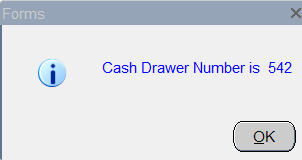
I have this little beast... The name of this is: Aliases.java.bufferedframeOciDev1RemoteSiteTc.windowFormsCashDrawerNumberIs542.buttonbar.ClickItem("OK"); The next time I run this test it will be named: Aliases.java.bufferedframeOciDev1RemoteSiteTc.windowFormsCashDrawerNumberIs543.buttonbar.ClickItem("OK"); I have tried several ways of replacing '543' with the var drawerNo, but then the object isn't found. If I do var winName = windowFormsCashDrawerNumberIs + drawerNo The object still can't be found. How can I get TC to recognize this window when it's name changes each time I run the test? I've recorded a keyword test several times, converted it to a script (JS) and made adjustments with no luck.98Views0likes2CommentsPassing Parameters from DevOps to Test Complete
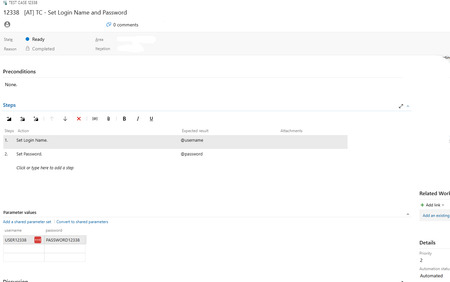
Hi, We are using on-prem DevOps Server 2020 Update 1.2 and Test Complete 15.81.7. I have created a simple Test Case in DevOps: That is supposed to pass the username and password to an automated test in Test Complete. The Test Case has a linked automated test in Test Complete and is run via a teat Suite / Test Plan and a pipeline. Does any one know how to get the parameters defined in the Test Case passed to Test Complete? Many Thanks Dave28Views0likes0Comments