Add Unity/Game Engine extension to TestComplete
https://support.smartbear.com/testcomplete/docs/app-testing/open-apps/index.html According to a support link above from SmartBear, the language (Unity/Game Engine) we used to develop our product (code name 15Tango) is NOT the on the list, therefore, our product is not an open app to TestComplete. TC15 can’t display the objects underneath our product, so we could not add “Checkpoints” on the objects from the product UI to validate testing requirements. Could SmartBear add Unity extension to TestComplete so it could test our product like it tests a product written in .Net easily? Unity/Game Engine based product market is rapidly growing. The engine can be used to create three-dimensional (3D) and two-dimensional (2D) games, as well as interactive simulations. The engine has been adopted by industries outside video gaming, such as film, automotive, architecture, engineering, construction, and the United States Armed Forces. A Unity extension to TC will benefit both SmartBear and our product for now and future.320Views2likes2Comments
OCR in UI Test Automation: Extending Coverage Where Traditional Identification Breaks Down
Automated UI testing increasingly operates in environments where traditional object identification is not reliable. Modern applications frequently render text and controls using custom graphics, canvases, charts, and dynamically generated visuals that do not expose accessible properties or stable locators. As a result, automation tools that rely solely on object hierarchies and properties can struggle to validate what is actually presented to the user. Optical Character Recognition (OCR) addresses this gap by enabling automation to extract and interpret text directly from what is rendered on screen. Instead of depending on the underlying implementation of a control, OCR works at the visual layer, analyzing pixels and patterns to recognize characters and convert them into machine readable text. This capability allows automated tests to validate user visible content in situations where traditional approaches fall short. Why OCR Matters in Real World UI Testing In many business critical applications, text is not always exposed through standard UI controls. Common examples include: Charts and dashboards rendered using custom drawing libraries Canvas based interfaces and rich graphical components Embedded documents such as PDFs or reports Custom buttons, labels, or alerts built without standard accessibility metadata In these scenarios, the risk is not just test fragility it is blind spots. If automation cannot confirm what text is displayed, teams are forced back to manual validation for critical user facing information. OCR enables tests to verify visible content regardless of how it is implemented. By converting visual text into actionable data, OCR allows teams to assert that values, labels, messages, and statuses shown to users are correct, even when object level access is unavailable. This makes OCR especially valuable for validating end-to-end business workflows where correctness depends on what users actually see, not just what the application internally represents. OCR as Part of TestComplete’s Object Recognition Strategy TestComplete incorporates OCR as part of its broader approach to handling complex and non standard user interfaces. OCR is available directly within the platform and can be applied to many different types of application testing without requiring separate tools or configurations. When TestComplete encounters unsupported or custom controls, OCR can be used to: Recognize text from a specified screen region Extract and compare visible text against expected values Locate UI elements based on displayed text rather than coordinates Interact with visual elements by identifying their text content OCR actions can be recorded automatically during test creation when traditional object recognition is not possible. Teams can also explicitly define OCR based checkpoints to validate messages, labels, and dynamic values that appear during test execution. By allowing interactions to be driven by recognized text instead of fixed screen positions, OCR based tests tend to be more resilient to layout changes and UI adjustments. See OCR in Action A short demonstration shows how OCR is applied in real testing scenarios, including recognizing text in custom or unsupported controls, validating user visible messages, and driving interactions based on on screen text rather than fixed coordinates. The demo focuses on practical use cases where traditional object identification is not available. Expanding Automation Coverage Without Increasing Fragility One of the persistent challenges in UI automation is balancing coverage with maintenance. Scripts that rely on brittle locators or coordinates often fail when visual layouts change, even if the underlying functionality remains correct. OCR helps mitigate this issue by anchoring tests to user visible content rather than implementation details. This is particularly useful for: Validating alerts or error messages drawn directly on the UI Verifying values inside charts or graphical widgets Testing applications with frequent visual refinements but stable business logic By enabling validation at the visual layer, OCR reduces the need for workarounds or manual testing in areas that were previously difficult to automate. The result is broader coverage with fewer fragile dependencies. OCR as a Bridge Between User Experience and Automation OCR is not intended to replace traditional object based testing. Instead, it complements it by extending automation into areas where conventional techniques are insufficient. Within TestComplete, OCR functions as a bridge between how users experience an application and how automated tests validate it. When automation can read and verify the same information a human user relies on, test results better reflect real world behavior and risk. As applications continue to evolve toward richer and more visually driven interfaces, OCR plays a key role in ensuring automated testing remains aligned with actual user experience not just underlying code structure.311Views2likes0CommentsStop Skimming PDFs, Start Automating PDF Testing
On the surface, PDFs look simple, but testing them is a whole different story. Invoices, contracts, statements, compliance reports… they’re often the last thing that lands in a customer’s hands. That also means even the smallest issue, like a missing field or a misplaced decimal, can turn into something big. The challenge is that PDFs aren’t like web pages or apps where you can easily inspect elements. They’re containers packed with content, layout, images, and data from different systems. When you add in dynamic content that changes for every customer, formatting that has to stay perfect, and the regulatory risks in industries like finance or healthcare, you start to see why manual testing just doesn’t cut it. It’s slow, inconsistent, and doesn’t scale. This is where automation becomes essential. With automation, you can make sure data is always accurate, layouts stay consistent, and testing scales across thousands of documents without slowing down your team. Instead of spending hours opening PDFs by hand, QA can focus on higher-value work while still knowing that every report or statement going out the door is right. That’s exactly where TestComplete comes in. It’s built to handle the tough parts of PDF testing so you don’t have to. You can validate content down to the last character, run visual checks to keep layouts consistent, and plug it all straight into your CI/CD pipeline. The result is faster releases, fewer headaches, and a lot more confidence that the documents your customers see are exactly as they should be.118Views0likes0CommentsAccessibility Testing Made Easy: How TestComplete Ensures Web Compliance
Most test automation focuses on functionality but in regulated industries like healthcare, finance, and education, teams must also prove accessibility and compliance. TestComplete’s Web Audit Checkpoints make this simple by integrating accessibility scans directly into automated tests, identifying errors like missing alt text, deprecated tags, and invalid HTML. Teams can set practical thresholds (e.g., zero critical errors, limited warnings) to balance enforcement and flexibility. This ensures every regression run checks not only if features work, but if they meet legal and usability standards. The result is faster compliance, reduced risk, and higher-quality user experiences for everyone. Check out our demo video to see how accessibility testing in TestComplete fits seamlessly into your automation pipeline and helps you build more inclusive, compliant web applications.102Views2likes0Comments
TestComplete Closing Issue in Debug Mode
Hi, I am testing a desktop application in TestComplete. When I choose Debugging mode, set a breakpoint, and run the test, the code goes to the next breakpoint and stays in a paused (breakpoint) state. After a short time, TestComplete closes automatically. Why is this happening, and can you please tell me how to resolve this issue?108Views0likes2Comments
Use Variables in the sql connectionstring
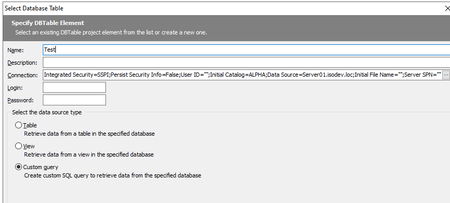
Hi there, I'm using 2 environments and 2 databases: 1 to create the testcases and 1 to execute them I want to check the results with DBTables Custom queries (SSMS) and I have i.e. next connectionstring: How CAN I make this string Variable ? When I login at the ALPHA-environment I want in the string ALPHA and server01 When I login at the BETA-environment I want in the string BETA and server02 Greetings, Sjef van IrselSolved1KViews0likes6Comments
Regex Checkpoint Javascript HELP!
Hello, Can anyone help me how to use regular expression for checkpoints, I've been trying to use it, but my checkpoint keeps failing. I think I am doing it wrong. I am trying to check if the property of an object returns an integer. My code is something like this: aqObject.CheckProperty(Object.Test, "Value", cmpMatches , RegExp("\d+")) Result: Thanks.Solved258Views0likes6CommentsPDF checkpoint - Ability to reference portions of the pdf
Our SUT produces PDF's, with an date-time stamp in the contents of the pdf. When comparing pdf's using checkpoint, a day later than today these checkpoints fail. Would it be possible to add a feature, for PDF checkpoints that you can indicate which portions of the pdf to compare? With that we can ignore the header in our pdf where the date-time stamp are printed, and thus the checkpoint passes.48Views0likes0CommentsAnti-aliasing issues on desktop applications messing with visual testing
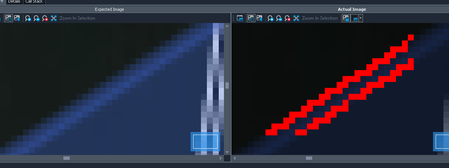
Hey, I'm having an issue with intermittent pixel issues on the edges of sections of lines. From the way the pixel changes manifest and the fact that they are almost unnoticeable to the naked eye they are due to anti-aliasing. I have turned off all the anti-aliasing setting I can find, but it still happens 9/10 times. has anyone come across this? if so have you been able to sort it without using tolerance? This is a WPF app being run on a physical windows machine.361Views0likes4Comments