Reuse adapted xml file and send in REST


Hi Humashankar
Thank you for your response. As this could be an option, I've decided to do this differently. I wanted to be able to use the objects from ReadyAPI together with groovyscript. How I did it:
A first groovyscript: to lookup the files in a local 'resource' folder. A lot of those files have different extensions.
def basePath = context.expand('${#Global#filePath}')

def sourceDir = new File(basePath + "/resources")

def files = sourceDir.listFiles()
        .findAll { it.isFile() }

def filePaths = files.collect { it.absolutePath }

testRunner.testCase.setPropertyValue(
        "fileList",
        filePaths.join("|")
)

testRunner.testCase.setPropertyValue( "fileIndex", "0")

log.info "FOUND ${filePaths.size()} FILES"
2nd step is use of Data Source. I gave a name to the property 'currentFile' and use this groovy:
def fileList =
    testRunner.testCase.getPropertyValue(
        "fileList"
    )

def index =
    testRunner.testCase.getPropertyValue(
        "fileIndex"
    ) as Integer

def files =
    fileList.split("\\|")

if(index >= files.size()) {

    log.info "NO MORE FILES"

    return false
}

result["currentFile"] =
    files[index]

log.info(
    "CURRENT FILE = " +
    files[index]
)
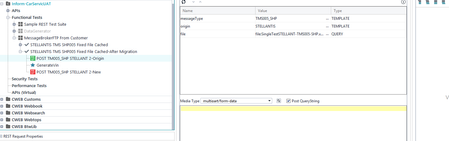
The 3rd step is the REST request where I've attached the original file, saved on project level , as multipart/form-data
Followed by another groovyscript that will check which type of file we need to tackle, change the random vinnumber and saved it in a local folder to be fetched again in a next step
import groovy.xml.*
import java.util.Random

// PATHS
// =====================================================
def basePath = context.expand('${#Global#filePath}')
def currentFile = context.expand('${Data Source#currentFile}')
log.info("CURRENT FILE = " + currentFile)

def inputFile = new File(currentFile)
if (!inputFile.exists()) {
    throw new Exception(
            "FILE NOT FOUND : " + currentFile)
}
def originalFileName = inputFile.name
log.info("FILE NAME = " + originalFileName)

// NEW VIN
// =====================================================
def newVin = {

    def chars = "ABCDEFGHJKLMNPRSTUVWXYZ0123456789"

    (1..17).collect {chars[new Random().nextInt(chars.length())] }.join()
}

// DISPATCHER
// =====================================================
def generatedContent
if(originalFileName.toLowerCase().endsWith(".xml")) {
    generatedContent = processXml(inputFile, newVin)
}
else if(originalFileName.toLowerCase().endsWith(".conv")) {
    generatedContent = processConv(inputFile, newVin)
}
else {
    generatedContent = processFlatFile(inputFile, newVin)
}

// XML
// =====================================================
def processXml(file,newVin) {
    def xml = new XmlParser(false,false).parse(file)
    boolean replaced = false
    xml.depthFirst().each { node ->
        if(replaced) return
        def nodeName = node.name().toString().toLowerCase()
        if(nodeName.contains("vin") ||
           nodeName.contains("vehicleid")) {
            log.info("FOUND XML NODE = ${nodeName}")
            node.value = newVin
            replaced = true
        }
    }
    return XmlUtil.serialize(xml)
}

// FORD CONV
// =====================================================
def processConv(file,newVin) {
    boolean replaced = false
    def lines = file.readLines()
    def updated = lines.collect { line ->
        if(!replaced) {
            def matcher = line =~ /(WF0[A-Z0-9]{14})/
            if(matcher.find()) {
                def oldVin = matcher.group(1)
                //log.info("FOUND FORD VIN = ${oldVin}" )
                line = line.replaceFirst( oldVin, newVin)
                replaced = true
            }
        }
        return line
    }
    updated.join("\n")
}

// DCUK
// =====================================================
def processFlatFile(file,newVin) {
    boolean replaced = false
    def lines = file.readLines()
    def updated = lines.collect { line ->
        if(!replaced) {
            def matcher =line =~ /(W1K[A-Z0-9]{10,20})/
            if(matcher.find()) {
                def oldVin = matcher.group(1)
               // log.info("FOUND DCUK VIN = ${oldVin}" )
                line = line.replaceFirst(oldVin, newVin )
                replaced = true
            }
        }
        return line
    }
    updated.join("\n")
}

// SAVE FILE
// =====================================================
def generatedDir = new File(basePath + "/generated")
if(!generatedDir.exists()) {
    generatedDir.mkdirs()
}
def generatedFileName = inputFile.name.replace( ".", "_" + System.currentTimeMillis() + "_generated.")
def fullPath =generatedDir.absolutePath + "/" +generatedFileName
new File(fullPath).write(
        generatedContent,
        "UTF-8"
)
//log.info "GENERATED FILE = ${fullPath}"
// generated file properties
testRunner.testCase.setPropertyValue( "generatedFile", fullPath)
testRunner.testCase.setPropertyValue("generatedFileName", inputFile.name)
//log.info("GENERATED FILE NAME = " +new File(fullPath).getName()

def currentIndex =
    context.expand('${#TestCase#fileIndex}') as Integer
log.info "INDEX BEFORE = ${currentIndex}"
testRunner.testCase.setPropertyValue(
    "fileIndex",
    (currentIndex + 1).toString()
)
log.info "INDEX AFTER = ${currentIndex + 1}"

// SET PARTNERNAME
// =====================================================
def detectPartner(fileName) {
    def knownPartners = [
        "FORD",
        "DCUK",
        "JLR-RAIL",
        "PDL",
        "PRI",
        "CarArrival",
        "STELLANT"
    ]
    for(p in knownPartners) {
        if(fileName.toUpperCase().contains(p.toUpperCase())) {
            return p
        }
    }
    return "UNKNOWN"
}
def partner =detectPartner(originalFileName)
testRunner.testCase.setPropertyValue( "partner", partner)
//log.info("PARTNER = " + partner)
5th step is the next REST request that fetches the newly create file.
and the last step is a cleanup from the previous step. You need to unattache the previous file so the newly created file can be added.
And it works as a charm!
Regards!


