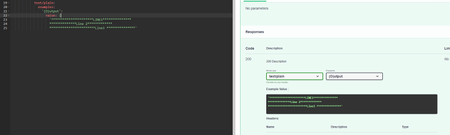
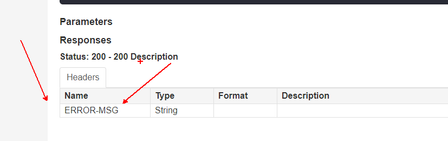
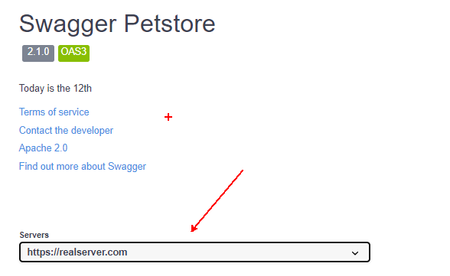
ContributionsMost RecentMost LikesSolutionsRe: Reusing the Header Parameter Have you tried securing your endpoints using one of the security requirement objects? https://swagger.io/specification/#security-requirement-object It seems that the issue is the fact that the header parameter is named authorization. Could you try naming the parameter something else? Re: Is there a limit to how many domains you can have? With a SwaggerHub Enterprise plan there is no limit, you can create as many domain documents as you like. With a SwaggerHub Teams plan, you can create up to 10 domain documents. With a SwaggerHub Free plan, you cannot create domain documents. Re: Can't add requestBody to GET call in OpenAPI 3.0 Thank you rickyxurq ! Having the parameters in the query or path were not an option for us, so we turned the operation into a POST call instead. Can't add requestBody to GET call in OpenAPI 3.0 I have an existing API endpoint with a GET operation. The GET operation takes several parameters and I currently have those parameters being sent in the body of the request. OpenAPI 3.0 no longer supports the requestBody object on GET requests (as seen here https://swagger.io/docs/specification/describing-request-body/), is there any way I can describe this API operation using OpenAPI 3.0 or does someone know of a workaround? SolvedRe: automatically ensure openapi.json matches my Express API endpoints tkeidar, 1. There are several different ways to generate OpenAPI documents based off of existing code/APIs. One option is to generate a document based off your code. These usually come in the form of annotations or something that integrates with your framework. I found one specifically for Typescript here: https://tsoa-community.github.io/docs/introduction.html You can also use the Swagger Inspector tool. This tool will allow you to make API calls to your services, and record both the request as well as the response. Once you've got a few request and responses recorded, you can generate a simple OpenAPI file. This won't be a complete solution as there may be a lot of details missing, but at least it will give you a strong jumping off point: https://inspector.swagger.io/builder 2. I've looked into this a little bit and I came across this website a while back: https://openapi.tools/. I think what you would want to take a look at is the Data Validator tools on this site. I haven't tested out any personally. Hope this helps! Re: Generate Client HTML: lost parameters matspring, I've found a stack overflow question that helped me break a long string into several lines: https://stackoverflow.com/questions/3790454/how-do-i-break-a-string-in-yaml-over-multiple-lines/21699210 Using the "|" symbol adds a line break to every line in your yaml file so your report is formatted properly in the SwaggerUI. I looked into the HTML document generation options and it doesn't look like there is any way to edit how the documents are created. The document generators appear to have been created by a company called Reverb (doesn't look like it exists anymore). One suggestion I have to solve this would be to create your own Swagger Codegen template for HTML. That way you could generate HTML docs based off your OpenAPI documentation. Hope this helps! Re: Missing some files when using swagger-codegen Hi jonmadethis, What framework/language are you trying to generate code for? Is it a client or server implementation? Also, what does your document look like? How many endpoints do you have? What about # of schemas/objects? Re: Generate Client HTML: lost parameters matspring, I think you're absolutely right in believing this is a limitation. I created a similar file in the editor, added a similar header to the response of my endpoint, and generated HTML documentation. I saw the same thing you did (missing header), and decided to take a look at the HTML file itself. What I found is that there was no evidence at all of my ERROR-MSG object in the HTML file generated, so it is completely ignored by that code generation option. I tried doing the same with the HTML2 option and was in fact able to get the header to show up. My recommendation would be to use this option if you want to generate HTML style API documentation. Let me know if you have any other concerns/questions! Re: Can you make a Swagger open source project private? lexie Swagger is the open source tooling surrounding the Swagger 2.0/OpenAPI 3.0 document specification. You should be able to download all the tools to your personal machine and use them privately. Where is your documentation being hosted? Are you using SmartBear's API Design tool SwaggerHub? Could you provide me a link to your documentation so I can better understand your question. Thanks, Alex Re: Adding Swagger to an existing java application gcorsar, Is this what you mean? The URL you want to query against is not available in the drop down in Swagger UI? If so, you need to add the proper URL to the available servers on your document. I'm not sure how to achieve this using a Swagger annotation tool, but it should be possible by editing the Swagger/OpenAPI document directly. What you need to do is edit your "servers" tag to look like so: Every value you add as a url to your servers tag will be added as an option to the dropdown list when the document is rendered in SwaggerUI. That way, when you "Try It Out" on one of your operations, the API call will be sent to the address you specified.

 StaffStaff