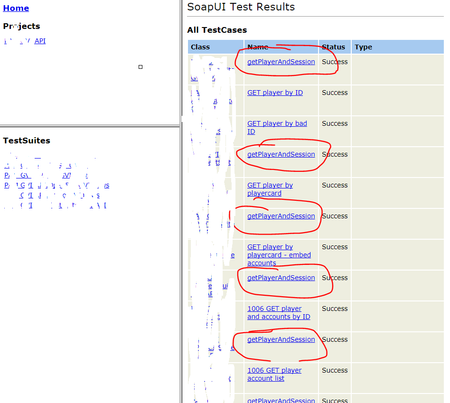
ContributionsMost RecentMost LikesSolutionsRe: How do i hide a testcase from reports? Heres screenshots of the report and the testcases in a suite. It does seem odd that getPlayerAndSession is up top even if it is disabled. Excuse my masterful removal of information. :) Re: How do i hide a testcase from reports? It will be a few days until i can post a screenshot. Meanwhile, i tried finding some more information about customizing reports, but it seems to be its own complexity. I have not learned how to use it yet, so can you recommend some reading material or just some ideas for approaching the problem, so i can search for the right things? The junit reports are great so all i need is to remove that one testcase. How do i hide a testcase from reports? Due to the security used with my api (josso) i have created a testcase that gets user information and their necessary sessionid. I then use the Run TestCase teststep in my testcases and get user information from that. The testcase itself is disabled and is only run from other testcases. My issue now is that the testcase shows up in reports, effectively doubling the reported amount of testcases which muddies results. How do i remove the testcase from reports? I use the junit style reports if that could be relevant. Equally interesting to me: is there a better solution? I'd like to stick to the GUI functionality to make it easier for others to maintain, but i cannot figure out if my "Bearer fixed_token.sessionId" header scheme can be supported along with getting user information from an excel sheet. Re: asserting unique ids I think i made sense of this, excuse incorrect terms and such below :) #Request is not correct as this is not the request i actually sent. When looking at #Request, the unique id changes every time and i shouldnt use it even if i could. It also seems like #Request is created as needed and as such doesnt exist when trying to grab something with jsonpath. (possible bug?) #rawrequest however is what i needed, and this works as expected. My unique id is the actual id use in the request and theres some actual content for my assertions. ${${=context.currentStep.label}#rawrequest#$.ID} has made my day a lot better. Thanks again for help and direction. Please let me know if i am horribly wrong and about to make everything worse :) Re: asserting unique ids Actually, trying it out i'm having some trouble. ${${=context.currentStep.label}#Request} works as expected. I get the full request body. The following gives me nothing at all: ${${=context.currentStep.label}#Request#} ${${=context.currentStep.label}#Request#$.id} I've tried some variations with no luck. I'm running SoapUI NG pro if that is relevant. Re: asserting unique ids Ofcourse. Thank you again. Re: asserting unique ids Thank you, you have saved me a lot of time. I felt like this should be possible but couldnt find the right information. Out of curiosity, can i do a self reference in a property expansion? If i can do something like ${#self#request} i won't have trouble if i copy/move/rename my things. asserting unique ids I would like to find sort of a "best practice" solution to this problem. I need to have an unique id with all my requests. I have to assert that the response contains the same id. If i make a small class that generates unique ids, i have an issue using property expansions in assertions, since one id will be sent in the request and another will be generated when i do the assertion. I can do a script assertion but that is fiddly and takes a long time due to the various structures of the responses. I would very much like to avoid property transfers and instead have a simple method to reference the request i just sent as my expected value. Is this possible with a jsonpath match assertion somehow? Solved