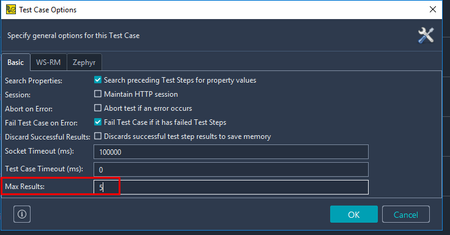
ContributionsMost RecentMost LikesSolutionsRe: Test case Options: Max Results - update via groovy testRunner.testCase.config.setMaxResults(int number) reference: https://support.smartbear.com/readyapi/apidocs/3.0.0/soapui/index.html?com/eviware/soapui/impl/wsdl/testcase/WsdlTestCase.html Test case Options: Max Results - update via groovy Hi, Does anyone know how to update the Test case options - max results property using groovy script? SolvedShare report instance Hi, I am using external lib for reporting. When I execute whole project or suite I would like to pass shared report object to each testCase so that I save all results in one report file. Something that I wanted to use is //////////// REPORT setup script if(!testRunner.hasProperty('report')){ //pseudo code //reporter = ... testRunner.metaClass.report = reporter } in TestRunListener.beforeRun event. However, I have noticed that the testRunner instance is not shared between the test cases (e.g. when I run whole suite). I believe for each testCase new testRunner is created. I am using 3.40.2 version of ReadyAPI Any help on this? Re: ReadyAPI UI get frozen when I try to Move Up/Down a TestSuite Have you upgraded or downgraded the ReadyAPI to different version than the project was initially created? Also do you use "Assertion" testStep in your suite.testCase.? Also is there any error logged in ReadyAPI when you try to move up/down? Re: AssertionGroup error messages? Grouping assertions in "Assertion" test step seems to return error messages. Re: Sharing custom class object between Groovy scripts Hi Mdar if I understood correctly your requirement I believe groovy's MetaClass Programming feature to store an object for sharing could be of help. Basically each Class can have metaclass in background that defines behaviour of the same class. Objects can be defined and shared. ReadyAPI example: - save the object: testRunner.metaClass.savedObject = objectToShare - then if I want to get the same object say for example from a test step (groovy script): def myObject = testRunner.savedObject AssertionGroup error messages? Hi, On soap request I have grouped few Assertions and now I fail to retrieve the error messages. If the assertions are not grouped I successfully retrieve the message as following: testRunner.getResults().each() { stepResult -> stepResult.getMessages().each() { message -> log.info message } } However this does not work for grouped assertions. I also noticed that Assertion Group does not create message header when you access failed request from testCase transaction log. Something else I've tried without success is following: for(assertionError in assertion){ log.info assertionError.getErrorLevel().toString() log.info assertionError.getMessage() } , or also: for(assertion in testStep.getAsertionList()) { assertion.DESCRIPTION //this returns the group name "Assertion Group" but don't know how to enter inside the group and print error messages from there } I would appreciate some help if someone knows how can I extract this error messages from groupAssertion using groovy script. SolvedSmart Assertion - assert logical/relationship contracts in response Hi, I have soap response with format similar to the following dummy example, ... <person> <firstName>xxxxxxxxxx</firstName> <lastName>yyyyyyyyyy</lastName> <phoneNumber>zzzzzzzzzz</phoneNumber> </person> ... Important to note is that node person has relation contract one to one. I have added Smart Assertion and I am asserting if node exists or attribute equals to value and etc. HOWEVER, we had a bug where this part of the response <person> node was doubled (one to many) and it bugged our system afterwards... and my Smart Assertion was not smart enough to detect that person is one to many instead of one to one. Is there a way to assert this in ReadyAPI using the provided assertions, let's say the Smart Assertion? Or perhaps this requirement is strong potential feature for ReadyAPI? Say there is an additional column in Smart Assertion where beside the 'Condition' you can define (optionally) the relation contract for the specific node or attirbute(such as the example above <person> must be one to one). Solved